
Binary options remain one of the clearest cases where the product risk and the scam risk tend to overlap. That is unusual. Many financial products are risky but lawful and routinely used by serious investors. Binary options developed the opposite reputation: major regulators concluded that retail clients were being harmed by the product itself, and fraud agencies continued warning that internet-based platforms offering binaries were often manipulated, misleading, or outright fake. The UK’s Financial Conduct Authority says that from 2 April 2019, firms were banned from selling binary options to retail consumers in the UK and that if you are offered binary options there, it is probably a scam. ESMA prohibited the marketing, distribution, and sale of binary options to retail investors in the EU, and ASIC banned their issue and distribution to retail clients in Australia because of significant detriment.
That alone should change the tone of the conversation. Binary options are not just “high risk” in the normal trading sense. In several major jurisdictions, retail access was restricted or banned because the product profile and sales practices were considered too harmful. In the United States, the legal position is narrower rather than permissive: some binary options may exist in regulated exchange form, but U.S. regulators have repeatedly warned that many online binary platforms are fraudulent or noncompliant.
So the right starting point is not curiosity about strategy. It is caution about structure.
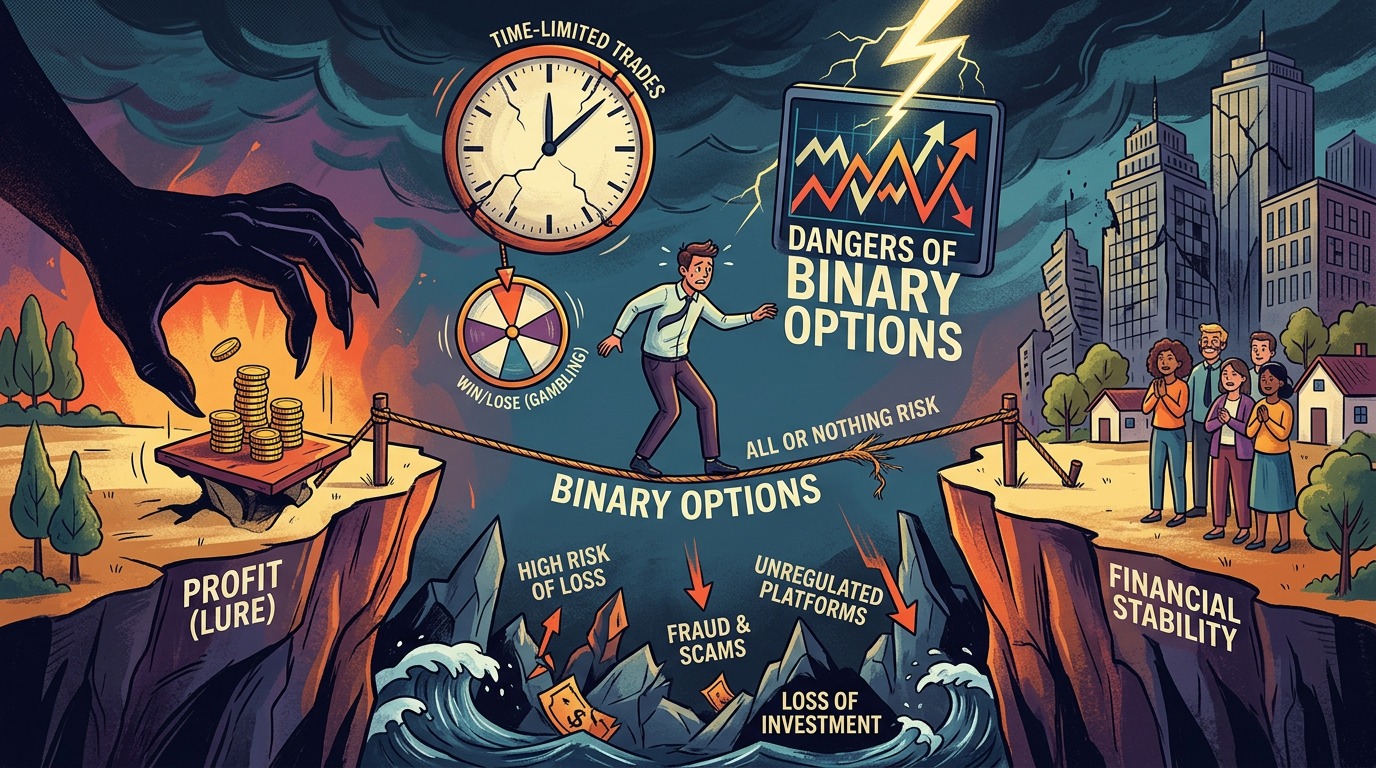
A binary option is a fixed-outcome wager on whether an asset will be above or below a specified level at a specified time. If the trader is right, they receive a pre-set payout. If they are wrong, they usually lose the full stake. The FCA’s consumer page describes the retail experience plainly: if the investor is correct, they “win” and should see a return; if they are wrong, they lose their full investment.
That all-or-nothing design is one reason the product feels simple to beginners. It removes the need to think in terms of gradual profit and loss, scaling out, or holding a position for a broader move. The platform presents a compressed choice: up or down, yes or no, short expiry, instant answer. That simplicity is a sales advantage. It is not a risk advantage. Binary options compress uncertainty into a very small window and turn a market view into a fixed bet with limited upside and very high downside relative to the stake. U.S. regulators have warned that many retail users misunderstand the expected return and that binary options websites often overstate likely profits.
This is also why the product attracts people who are not prepared for its real payoff profile. The interface looks like trading. The economic structure often behaves more like betting.
Regulators did not move against retail binary options because the charts were volatile or because some traders lost money in the ordinary way. They moved because the product and the way it was sold produced a pattern of consumer harm that was unusually persistent.
The FCA’s 2019 statement says its permanent UK ban on retail binary options could save consumers up to £17 million per year and reduce the risk of fraud by unauthorized firms claiming to offer them. Its separate consumer page goes further in plain language: if you are offered binary options in the UK, it is probably a scam.
ESMA’s 2018 intervention described “significant investor protection concerns” and prohibited the marketing, distribution, or sale of binary options to retail investors across the EU. That is an unusually strong step for a major European regulator, and it reflected both poor product outcomes and bad market conduct around the product.
ASIC took the same broad view. Its product-intervention order banned the issue and distribution of binary options to retail clients from May 2021 after finding that the products had resulted in, and were likely to result in, significant detriment to retail clients. ASIC later extended that ban until 2031.
In the U.S., the framing is slightly different because some exchange-traded binary options can exist in regulated form. But the CFTC and SEC still issued a joint investor alert warning about internet-based binary options fraud, including refusal to credit customer accounts, identity theft, and software manipulation to generate losing trades. Investor.gov also warns that some online platforms manipulate prices, payouts, and even expiry timing.
The pattern is consistent across jurisdictions. Binary options did not just attract bad actors. They gave bad actors an unusually convenient product wrapper.
The first underestimated risk is payout asymmetry. Many beginners focus on win rate and ignore payoff structure. If you stake 100 and the broker pays 70 to 90 on a winning trade, but you lose the full 100 on a losing one, the math is already working against you unless your win rate is high enough to clear that hurdle consistently. U.S. regulators have warned that in many scenarios an investor should expect, on average, to lose money.
The second underestimated risk is expiry compression. Short expiries feel attractive because they create fast feedback, but they also make results more sensitive to noise, random price movement, and spread-like distortions in the quoted price path. A trader can have the right broad market view and still lose because the contract horizon was too short and too binary for that view to matter. That is one reason the product often trains users to think in terms of rapid outcome chasing rather than robust analysis.
The third underestimated risk is platform dependency. In most mainstream financial markets, price discovery happens in broader market venues and the broker is mainly an intermediary. In many binary options setups, the user is far more dependent on the platform’s own pricing, timing, and payout logic. That creates room for opaque behavior. SEC and CFTC alerts specifically mention complaints that software was manipulated to distort prices and payouts or to convert apparent winners into losers.
The fourth underestimated risk is false familiarity. Binary options are often marketed using language borrowed from forex, stocks, or crypto. That encourages users to think they are engaging in ordinary speculative trading with a simpler interface. They are not. The contract structure is materially different, and in many places the legal and consumer-protection environment is much worse.
The fifth underestimated risk is that losses can escalate psychologically faster than in ordinary trading. The all-or-nothing structure creates a natural temptation to “win it back” with another short-duration position. Regulators and state-level investor alerts have long warned that victims are often pressured into depositing more after losses and are later targeted by follow-on recovery scams.
Scammers like binary options because the product already contains ambiguity, speed, and limited external price verification. That makes it easier to hide fraud inside what looks like a legitimate trading service.
The CFTC says complaints in off-exchange binary options schemes include refusal to return funds, hidden fees, manipulated charts, overstated returns, and bonus structures that trap users in turnover requirements. Investor.gov similarly warns that purported binary-options platforms may manipulate software, distort prices and payouts, and make withdrawals difficult or impossible.
This is where the product risk becomes scam risk. A trader may think they are taking market risk, when in fact they are taking platform risk, legal-jurisdiction risk, and counterparty risk at the same time. That is much harder to manage than ordinary trading risk. The result is that many users are not just wrong on market direction. They are exposed to a business model that may not be fair even before the first trade starts.
That is also why you should treat “offshore broker,” “bonus account,” “VIP signals,” and “guaranteed win rate” as part of the same problem, not as separate features. In binary options, those features often belong to the risk architecture, not to the convenience layer.
The best risk-management decision is not to trade retail binary options at all in jurisdictions where the product is banned, heavily restricted, or overwhelmingly associated with scams. That is the cleanest answer. But if someone insists on exploring the product despite the warnings, the practical goal should shift from “how do I win” to “how do I reduce the chance of catastrophic loss or being trapped in a scam.”
Start with legality and jurisdiction. If you are in the UK, retail binary options are banned; if you are offered them, the FCA says it is probably a scam. If you are in the EU or Australia, retail access is likewise prohibited or banned in the mainstream regulatory framework. In the U.S., the only remotely defensible path is through genuinely regulated exchange or contract-market structures, not through random internet platforms.
Next, assume that any broker or platform selection process should begin with distrust. Verify the legal entity, not the website design. Check the relevant regulator database yourself.
Avoid bonuses. This is not a cosmetic point. CFTC warnings explicitly mention bonus schemes that create hidden or restrictive withdrawal conditions. If a platform offers free trading credit, welcome bonuses, or “risk-free” first trades, assume the terms are there to slow or block withdrawals later.
Prefer demo testing before any live deposit, and keep the first live deposit minimal if you proceed at all. The objective is not to “start properly.” It is to test whether the deposit, execution, and withdrawal mechanics are even credible before exposing meaningful capital.
Finally, separate educational experimentation from income expectations. If you are treating binary options as a way to make regular money, you are already in the most dangerous psychological position.
If you still decide to look at binary options despite the risks, BinaryOptions.net can be useful in a narrow, practical sense. The site describes itself as an independent educational and review website focused on factual, regulation-aware information designed to reduce risk and improve decision-making. It publishes broker reviews, a scams blacklist, methodology pages, risk-management guides, and responsible-trading material. Its own trust and methodology pages say brokers cannot pay for higher ratings and that trust and safety sit at the center of its testing process.
That means it can help you minimize some avoidable mistakes if you insist on researching the space. Its scam pages and blacklist can help you recognize common fraud patterns. Its risk-management pages can help you think about stake sizing, daily loss limits, and the fact that binary options become more like gambling when traders ignore position discipline. Its responsible-trading content can also be useful because it treats loss-chasing, “one last win” thinking, and emotional deterioration as real risk factors.
But the limit is just as important. BinaryOptions.net does not remove product risk, legal risk, or jurisdiction risk. It also openly reviews offshore and sometimes unlicensed brokers, while explaining why and how it vets them. That may be informative, but it does not turn an offshore platform into a strong regulatory environment. The site itself says regulation is still preferable and that offshore or unlicensed providers remain a high-risk area.
Binary options deserve a harder warning than most speculative products because the normal trading risks are often fused with platform abuse, weak regulation, and outright fraud. That is why major regulators in the UK, EU, and Australia moved so aggressively against retail distribution, and why U.S. agencies have kept warning about internet-based binary options fraud.
If you still decide to test the product, keep the objective narrow and defensive. Verify the legal status first. Assume offshore setups are much riskier. Keep deposits small. Refuse bonus structures. Use resources such as BinaryOptions.net for scam screening, broker-review context, and risk-management education, but do not confuse education with safety.
The blunt version is the correct version: with binary options, your money might be at risk not only because your market call can be wrong, but because the whole environment may be stacked against you before the first contract expires.